Crimean Bridge Strike Severely Disrupts Russia's Grain Exports from the Sea of Azov
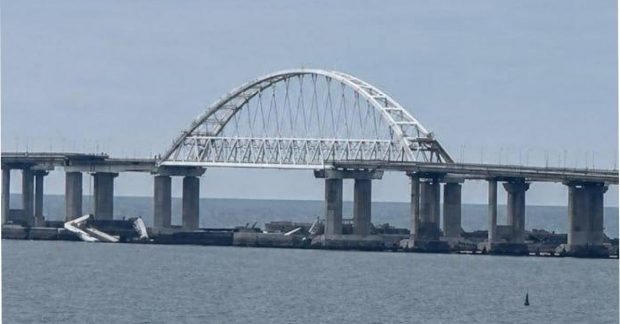
The damage to the Crimean Bridge during the night attack on November 17 has significantly limited Russia's logistical capacity to export grain through the Sea of Azov, including stolen Ukrainian agricultural products.
 🇺🇦Ukraine
Photo: UNIAN
Key points
- The Crimean Bridge damage on November 17 complicated Russian grain exports from the Sea of Azov.
- Azov ports accounted for 27% of Russian grain exports last season.
- The occupiers lost the ability to use Mariupol and Berdyansk ports for grain shipments.
- Clearing the channel from debris could take months.
The strike on the Crimean Bridge on the night of November 17 dealt a heavy blow to the Russian Federation's export logistics in the Azov region. According to port industry experts, it will now be much harder for Russia to export grain through Azov ports, which accounted for 27% of Russian grain exports last season, totaling 14.7 million tons.
Logistical Consequences and Occupied Territories
The majority of products from this region were traditionally shipped to Turkey and Middle Eastern countries. However, following the new bridge damage and ongoing restrictions in the Kerch Strait, the aggressor's plans to restore full-scale shipping have been jeopardized. According to Olir Resources CEO Ivan Niyakyi, Russia previously used the occupied ports of Mariupol and Berdyansk to export stolen Ukrainian grain, but this channel is now effectively blocked.
An additional problem for shipping in the area is the risk of river-sea class vessels becoming trapped ahead of the winter season and the closure of navigation on the Don-Volga canal. Clearing the navigation channel of bridge debris could take months, as such operations require heavy floating equipment under constant security threats.
Source UNIAN — unian.ua/economics/agro/kerchenskiy-mist-urazili-sili-oboroni-ekspo… ↗
Read next
 🏙️City
Global Warming and the 'Awakening' of Ancient Bacteria: New Research Findings
Researchers from the University of Colorado discovered that bacteria frozen in permafrost for 40,000 years can regain activity when temperatures rise.
 🎭Culture & Sport
A 350-kilogram giant pumpkin: Cherkasy region resident sets unofficial record
A resident of Smila grew a massive pumpkin on his plot, becoming the largest in Ukraine, and shared the harvest with the public.
 🛡️Security
US Director of National Intelligence: Putin is not a friend of America regarding the war in Ukraine
Director of National Intelligence Jay Clayton stated that Vladimir Putin is not a friend of the US, despite recent remarks by Donald Trump.
 🛡️Security
Tragedy in Dymer: Death toll from Russian attack rises to eight
Rescue operations are ongoing in Dymer, Kyiv region, where the death toll from a recent attack has reached eight.
 👥Society
Clashes at Kyiv Pechersk Lavra: Police launch investigation
A conflict broke out at the Kyiv Pechersk Lavra over disputes regarding the use of religious buildings. Law enforcement officials have recorded the incident and are condu…
 👥Society
ISW analysts assess the possibility of humanitarian evacuations: why the situation in Donetsk and Kherson regions differs
The Institute for the Study of War explains why organizing humanitarian corridors in the Donetsk region is technically more complex than along the Dnipro River.